

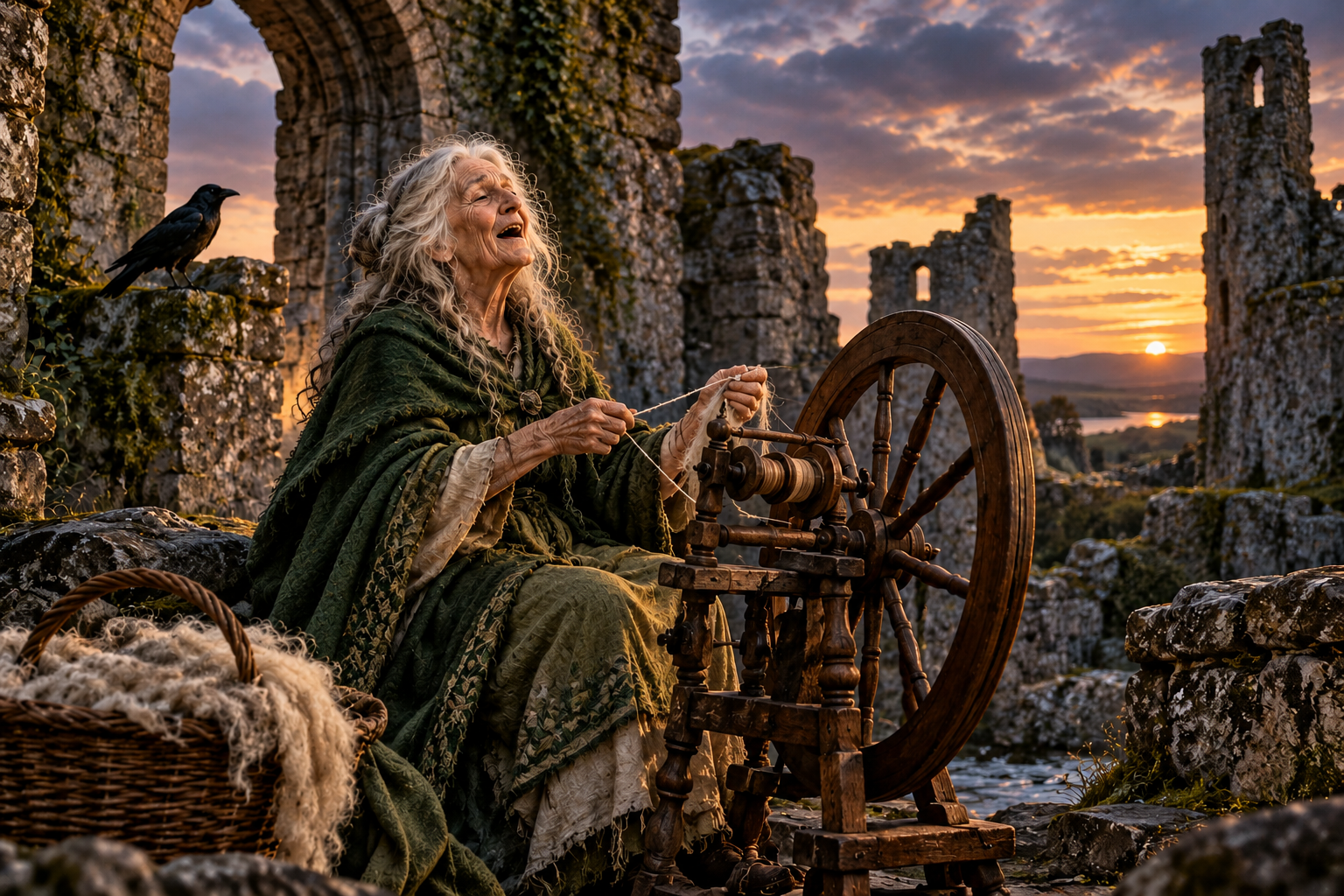
The Tale of Whuppity Stoorie
This is a tale from the border region of Scotland and is considered the Scottish version of Rumplestiltskin. The similarities are very clear as the story goes on. It was originally collected by Robert Chambers in his Popular Rhymes of Scotland in 1826.
The tale takes place in a place called Kittlerumpit - this is widely believed to be a made up location, and potentially somewhere along the historic Debatable Lands of the Scottish English border region.
The Origin Story
In the borderlands village of Kittlerumpit there was a goodwife whose husband went one day to the fayre and never returned. He was a faithless sort of man and not to be depended on. All the village pitied the goodwife’s plight, but none helped her. She had naught left but her house, her prize sow, and her baby boy. Her one hope was that the sow would soon give birth to piglets and if all went well, her stock would be much increased. But, it was not to be it seemed, for one morning when she went to the pigsty she found the sow lying on her back, groaning and grunting like she was at death’s door. This was a sore blow to the goodwife’s heart, and she sat down on the knocking-stone and cried harder than she ever had over the loss of her husband.
Then, as she sat wiping her eyes, she chanced to look down the brae, and what did she see but and little, old woman making her way up the hill towards the house. She was dressed all in green and she walked with a long walking stick, as tall as she was, to help her on her way.
Seeing the gentlewoman draw near, the goodwife rose and made a curtsy. Weeping, she said “Madam, I’m the maist unfortunate woman alive.”
“I ken ye’ve lost your goodman; and I ken that your sow’s sick. Noo, what will ye gie me to cure her?” said the green woman
“Onything your leddyship’s madam likes,” said the goodwife, unaware of with whom she dealt.
The green woman marched into the pigsty. She glowered at the sow for some time, then began to chant so as the goodwife could barely hear, “Pitter patter, Haly Watter.” Then from her pocket she drew a small bottle with something oily inside it and daubed the liquid around the sow’s snout, behind her ears, and on the tip of her tail. “Get up, beast.” Said the green woman, and no sooner than she’d said it, the sow leapt to her feet and, quite the thing, was away to her breakfast trough.
The goodwife of Kittlerumpit was overcome with joy, but then the Green woman asked for her fee - which was the goodwife's baby boy
The goodwife let out a gasp, for now she saw what she hadn’t before: the green woman was a fairy. Falling to her knees she wept and prayed and begged but the fairy would not relent. If the goodwife could find out her true name in three days time, she would not take the baby away.
For a night and a day, the goodwife could do naught but cry and hold her baby to her chest.
On the second day, at a loss for what to do she went walking in the woods, baby in her arms. She walked deep into the forest to where an old quarry lay, grown over with gorse and home to a spring well. As she approached, she caught the sound of a lint-wheel turning, and a soft voice singing. The goodwife crept closer and peered through the bushes into the quarry below.
There was the green fairy, working at her wheel and singing:
“Little kens our good dame at hame
That Whuppitie Stoorie is my name!”
And then the goodwife’s heart was light once more, for she had the magic word. She walked home with a spring in her step, gleeful at the thought of tricking the old fairy.
Feeling much like her old self again, the goodwife thought to have some sport with the fairy. On the third day, at the appointed time she put her baby behind the knocking-stone, then sat down on it herself, nightcap askew, a look of great woe on her face. Before long, the green fairy appeared over the hill and called out, “Goodwife o’ Kittelrumpit, ye ken weel what I come for – stand and deliver!”
The goodwife pretended to weep even harder than before and fell to her knees crying, she begged the fairy to take the sow instead, but she wouldn't.
The goodwife then begged the fairy to take her her instead of her baby. The fairy declined again.
Then, up the goodwife leapt and set her nightcap straight and making a low curtsy. “In troth, fair madam,” she said, “I might hae had the wit to ken that the likes o’ me is nae fair to tie the warst shoe strings o’ the high and mighty princess, Whuppity Stoorie!”
At that Whuppity Stoorie nearly jumped out of her skin, then turning on her heal she ran down the hill, screeching her rage for all of Kittlerumpit to hear.
The goodwife of Kittlerumpit laughed until her sides ached, then picked up her baby and went into her house, singing all the way: “A goo and a gitty, my bonny wee tyke, Ye’s noo hae your four-oories; Sin’ we’ve gi’en Nick a bane to pyke Wi’ his wheels and his Whuppity Stoories.”
Key Locations

Located just a short distance from St Abbs and the coast, this historic village is known for its peaceful charm and the impressive medieval ruins of Coldingham Priory
Coldingham

A quiet and scenic village nestled in the southeastern corner of the Borders near the coast. It features traditional tile-roofed cottages and historical landmarks like a 16th-century Mercat cross
Cockburnspath

A dramatic coastal fishing village perched on rugged cliffs above the North Sea. It features a picturesque harbour, local seafood cafés, a famous lighthouse, and walking trails (and famously served as New Asgard in Avengers: Endgame)
St. Abbs
Continue Your Journey Through Storied Landscapes
Explore another legend from North East England and the Scottish Borders.
Next story: The Story of Myself
Love the folklore of North East England and the Scottish Borders?
Join the Storied Landscapes Community to receive new legends, reimagined tales, and exclusive folklore maps and stories delivered straight to your inbox.