

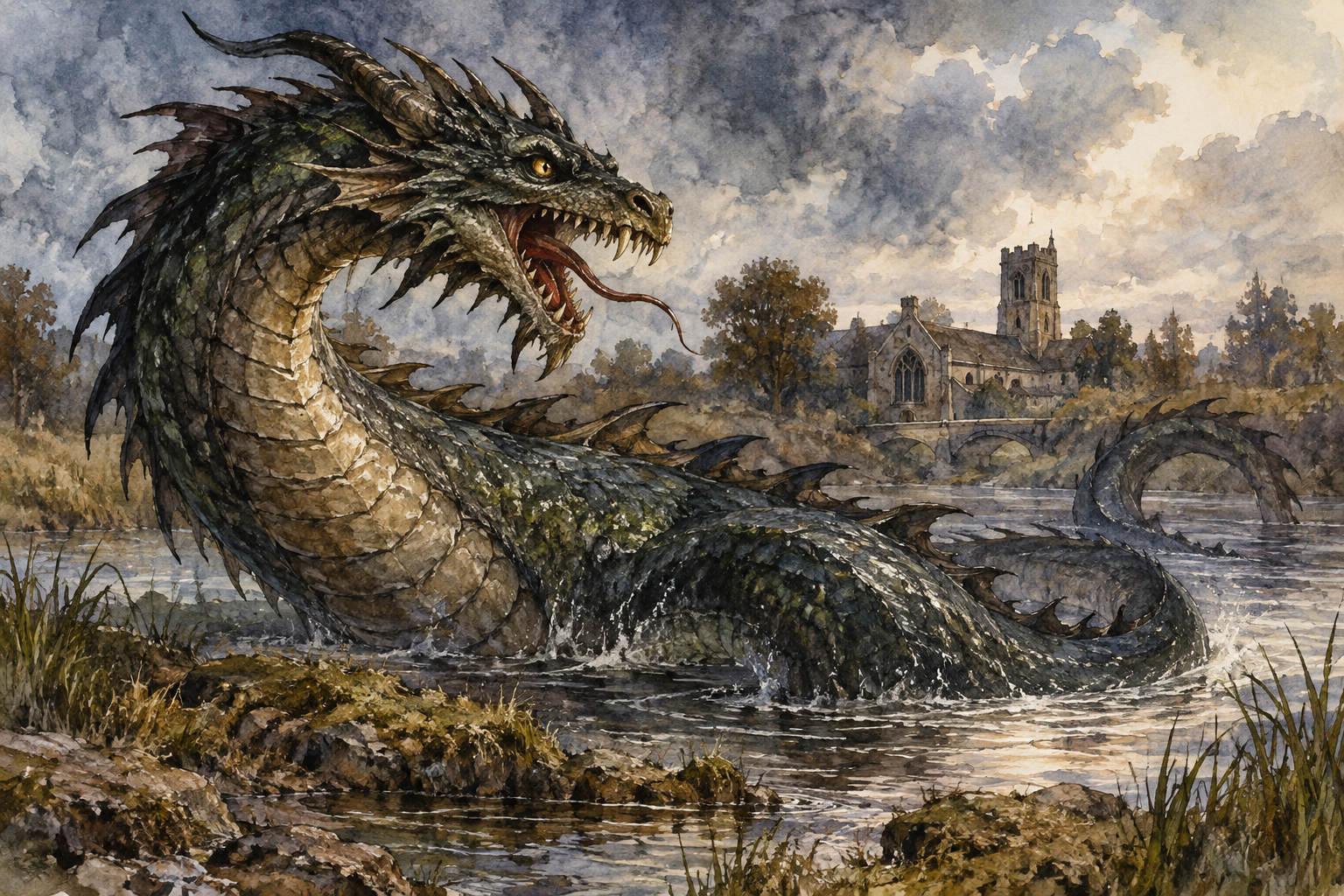
The Sockburn Worm
The Sockburn Worm is a legendary English dragon-like creature said to have terrorized the village of Sockburn in County Durham before being slain by a brave local knight named Sir John Conyers.
The Origin Story
The worm was described as a venomous, winged wyvern with a toxic breath so foul and deadly that it sickened people and destroyed livestock and local villagers.
The Hero of the story, Sir John Conyers faced the monster armed with a trusty falchion (a broad, single-edged curved sword). Legend says that before fighting the beast, he offered his only son to the Holy Ghost at All Saints' Church in Sockburn for divine strength.
Conyers struck down the beast and threw its remains into the nearby River Tees. A grey stone, known as the "Graystone," still marks the spot where the serpent allegedly lay.
The sword that allegedly was used to slay the worm is real, known as the Conyers Falchion, which is safely kept and displayed at Durham Cathedral.
For centuries, a unique tradition required the Lord of Sockburn to present this falchion to every newly appointed Bishop of Durham as they first crossed the River Tees into the county, symbolizing land tenure and loyalty.
Key Locations

Sockburn is a historic English hamlet located inside a sharp loop of the River Tees south of Darlington in the ceremonial County of Durham. First recorded as Soccabyrig around AD 780, it served as an early Anglo-Saxon religious site where Higbald, Bishop of Lindisfarne, was consecrated in 780 or 781
Sockburn

The Conyers falchion was traditionally used as a ‘sword of tenure’ or tenancy for the lands the family held from the Bishops of Durham. The head of the Conyers family presented each new Prince Bishop with this sword as a symbol of his loyalty, and the Bishop’s worldly power. The Bishop would then return the sword to him in acknowledgment.
Durham Cathedral

Jabberwocky Inspiration: The tale of the Sockburn Worm is widely believed to have inspired Lewis Carroll's famous nonsense poem Jabberwocky. Carroll grew up nearby in Croft-on-Tees, where his father was a rector and familiar with the local legend and the falchion (the likely inspiration for the poem's "vorpal blade")
Croft on Tees
Continue Your Journey Through Storied Landscapes
Explore another legend from North East England and the Scottish Borders.
Next story: The Shellycoat
Love the folklore of North East England and the Scottish Borders?
Join the Storied Landscapes Community to receive new legends, reimagined tales, and exclusive folklore maps and stories delivered straight to your inbox.